neu Reliable backup~ your peace of mind
The $10,000 Chalk Mark: The Hidden Cost of “Cheap” Office Water in the Philippines
From Cost-Centric to Value-Centric Thinking
4/28/20262 min read
The $10,000 Chalk Mark: The Hidden Cost of “Cheap” Office Water
From Cost-Centric to Value-Centric Thinking
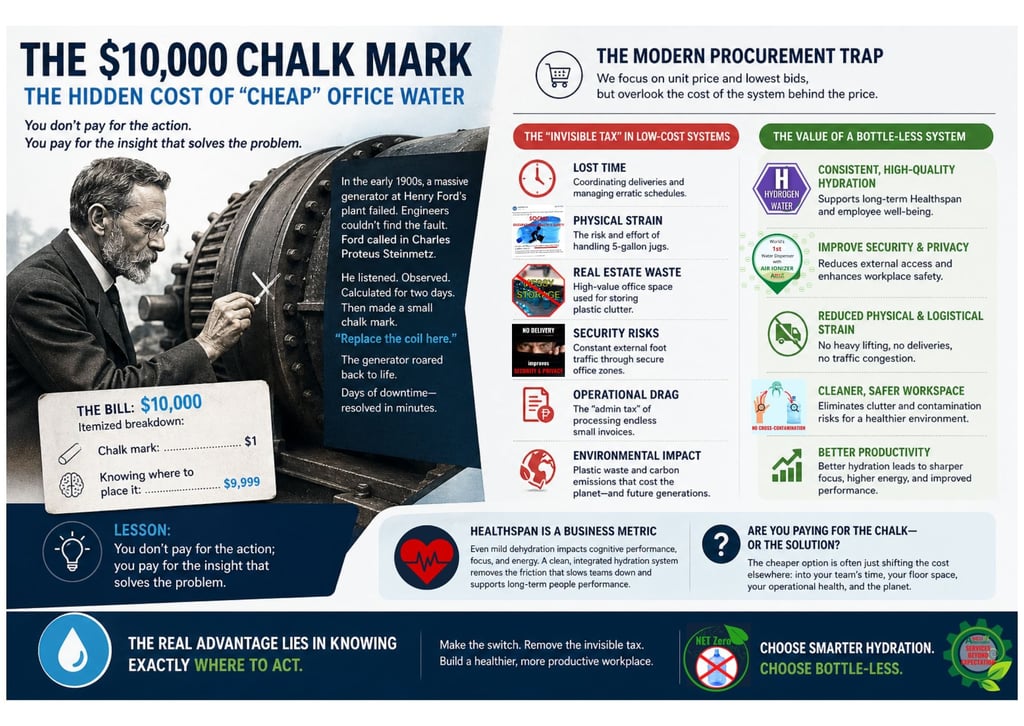
In the early 20th century, a massive generator at Henry Ford’s plant failed—bringing production to a standstill. His best engineers were stumped. In desperation, Ford called in the "Wizard of Schenectady," Charles Proteus Steinmetz.
Steinmetz arrived with no heavy tools and no large team. Just a notebook and a piece of chalk.
For two days, he listened. He observed. He calculated. Finally, he climbed up the machine, made a small chalk mark on the casing, and said: “Replace the coil here.”
The generator roared back to life. Days of downtime were resolved in minutes.
The bill? $10,000. When Ford asked for an itemized breakdown, Steinmetz famously replied:
Chalk mark: $1
Knowing where to place it: $9,999
Ford paid without hesitation. He understood a principle many still miss today: You don’t pay for the action; you pay for the insight that solves the problem.
The Modern Procurement Trap
In today’s corporate environment, procurement decisions are often trapped by a single question: “What is the unit price?” We compare vendor bids based on the lowest visible cost, assuming that a lower invoice equals a more efficient business.
But this approach overlooks the most expensive factor in any operation: The cost of the system behind the price.
The "Invisible Tax" and environmental impact that compounds over time in “Low-Cost” Systems
Take something as routine as office drinking water. Traditional bottled delivery systems look “cheap” on paper because of lower upfront pricing. But beneath that visible cost lies a hidden layer of friction—an Invisible Tax paid in:
Lost Time: Coordinating deliveries and managing erratic schedules.
Physical Strain: The risk and effort of handling 5-gallon jugs.
Real Estate Waste: High-value office space used for storing plastic clutter.
Security Risks: Constant external foot traffic through secure office zones.
Operational Drag: The "admin tax" of processing endless small invoices.
Healthspan is a Business Metric
A bottle-less water system flips the equation. It isn't just about "delivering water"; it is about biological maintenance. We know that even mild dehydration impacts cognitive performance, focus, and energy levels. When we treat hydration as a strategic asset rather than a commodity, we move toward Healthspan—supporting the long-term performance of our people.
A clean, integrated hydration system doesn’t just support compliance; it removes the physical and mental "friction" that slows a team down. Over time, these small inefficiencies compound into measurable productivity loss
Are You Paying for the Chalk—or the Solution?
The next time a decision comes down to the lowest bid, pause. The "cheaper" option is often just shifting the cost elsewhere: into your team’s time, your floor space, and your operational health.
The organizations that move ahead today are not the ones chasing the lowest price.
They are the ones reducing hidden cost.
Just like Steinmetz, the real advantage lies in knowing exactly where to act.
Experience safe hydration with our innovative dispenser.
Contact us
Your inquiry
0917-858 1425
© 2024. All rights reserved.